
General Information Notice This article is for general educational and informational purposes only. It is not medical advice, does not promote any service or product, and does not promise any health outcome. Individual experiences vary. For any health-related question, please consult a qualified, licensed healthcare professional.
A Brief History of Hijama
Hijama, commonly referred to in English as cupping, is one of the oldest documented traditional practices, with references found in ancient Egyptian, Chinese, Greek, and Middle Eastern medical texts. The Arabic word Hijama derives from the root al-hajm, meaning "to draw out."
Across many cultures, Hijama has been preserved as part of traditional medicine for thousands of years. In the Islamic tradition, it is also referenced within the Sunnah, and remains a culturally significant practice across the Gulf region today.
How Hijama Is Generally Described
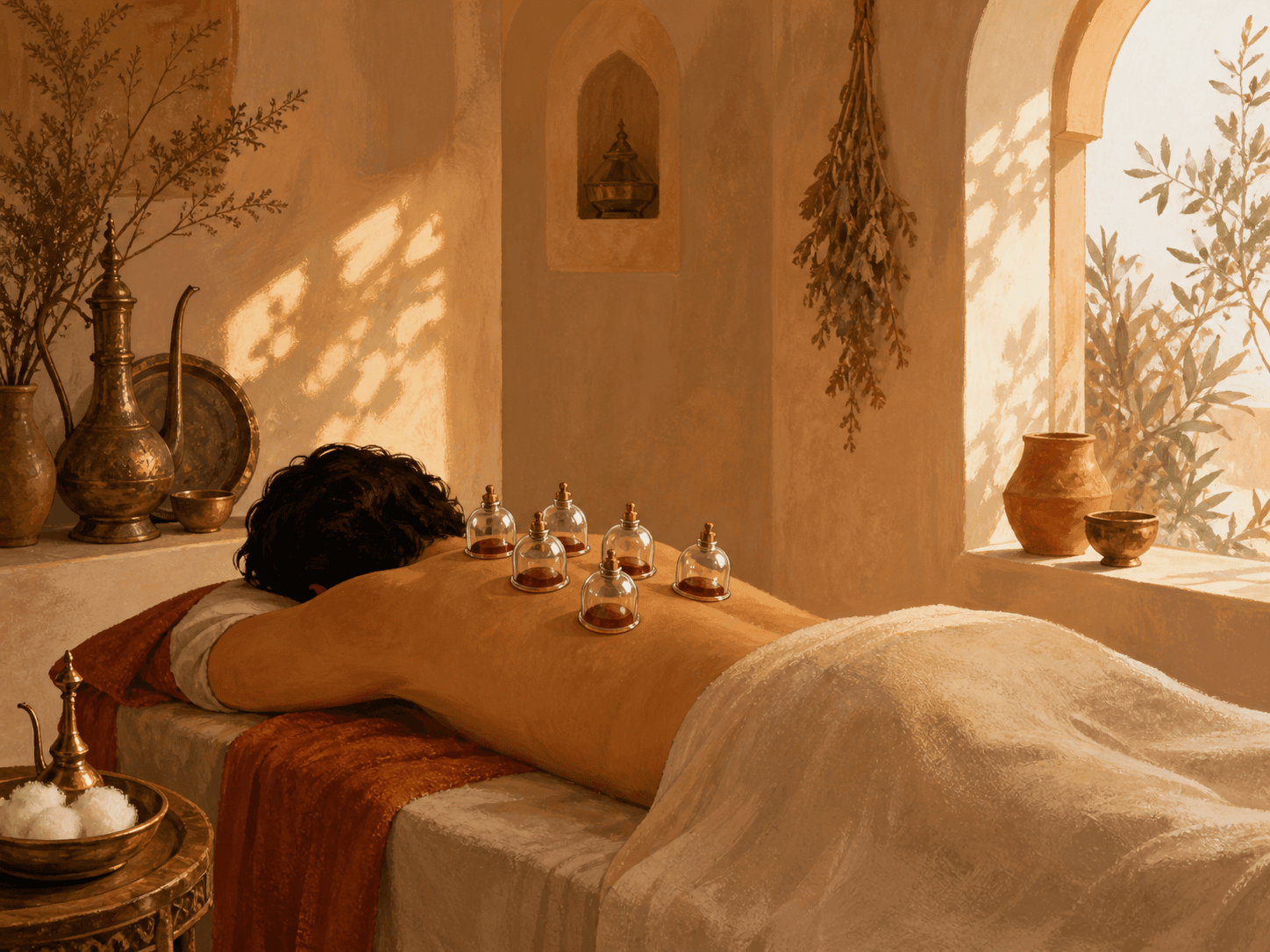
Hijama is generally described as a practice in which sterile suction cups are placed on specific areas of the body. Two forms are commonly described in traditional and academic literature:
- Dry cupping, which uses suction only.
- Wet cupping (traditional Hijama), which involves small superficial micro-incisions performed by a trained practitioner using sterile, single-use equipment.
The choice of technique, placement, and duration is made by a qualified practitioner during a private consultation, based on the individual's circumstances. This article does not recommend any specific procedure.
Regulatory Context in the UAE
In the United Arab Emirates, Hijama may only be performed within licensed healthcare facilities by qualified practitioners. Such facilities are subject to the regulatory standards of the Dubai Health Authority (DHA) and the Ministry of Health and Prevention (MOHAP), including standards on hygiene, single-use disposables, practitioner certification, and patient safety.
This regulatory framework is intended to ensure that traditional practices are offered within a safe, transparent, and clinically accountable environment.
General Safety Considerations
Traditional and complementary practices are not suitable for everyone. As a general principle, individuals should always consult a qualified medical professional before considering any such practice, particularly if they:
- Are pregnant or breastfeeding
- Are taking blood-thinning medication
- Have a bleeding disorder, severe anemia, or other significant medical conditions
- Have an active skin condition or infection in any area that might be involved
Suitability for any specific individual can only be determined in a private consultation with a licensed practitioner. This article does not constitute such an assessment.
How a Hijama Session Is Typically Structured
Within a licensed healthcare setting, a Hijama session is generally structured around the following stages:
- Consultation — A licensed practitioner reviews the individual's health background and discusses suitability.
- Preparation — A private, sterile environment is prepared using single-use equipment.
- Session — The practitioner conducts the session in line with established hygiene and clinical standards.
- General aftercare guidance — Information about rest and hydration is provided.
Specific protocols, duration, and any decision regarding suitability are determined solely during a private consultation with a licensed practitioner.
Further Reading
For official, non-promotional information on traditional and complementary medicine in the UAE, the following public resources may be useful:
- Dubai Health Authority (DHA) — public health information portal
- Ministry of Health and Prevention (MOHAP) — federal health information portal
- World Health Organization (WHO) — WHO Strategy on Traditional Medicine
This article is provided as general information only and is not a substitute for advice from a qualified healthcare professional.